

April, 2017.
 Alma mater of Albert Einstein and the Ultimate Ivory Tower to many academicians, The Institute of Advanced Studies, Princeton is in the words of Jack Matlock, former Ambassador to the Soviet Union “the closest thing you can find to a paradise-on-earth.” Vartan Gregorian, currently the President of the Carnegie Corporation calls it “the university to universities.”
A total of Thirty-three Nobel Laureates in physics, medicine, literature, chemistry, and economics and Forty-one Field Medalists out of a total of fifty-six have been Faculty, Members, or Long-term Visitors at the Institute. Notables, apart from Einstein, include Kurt Godel, perhaps the greatest mathematical logician of the century; John von Neumann, widely credited with inventing the computer and game theory; J. Robert Oppenheimer, the lead architect of the atomic bomb; George F. Kennan, a primary author of America’s cold war policy of containment and an Ambassador to Moscow; and Edward Witten, a mathematical physicist and the subject of a Manchester Guardian article whose headline asked, ”Is this the cleverest man in the world?”.
”By almost any measure, the permanent faculty of the Institute is one of the most remarkable collections of scientific minds on the planet,” according to ”Science Watch,” a newsletter that monitors research around the world. ”Papers in the physical sciences published during the last decade by this institute exhibited the highest citations-per-paper record of any research organization on earth.”
 Surprisingly, the Institute seems to exist largely beyond public consciousness. It’s located right on the edge of Princeton, but even people who have lived in Princeton for their whole life often can’t tell where the Institute is. If few Princetonians can say where the Institute is situated, fewer still can actually define it. ‘Think tank,’ which implies scholars for hire, is wrong,” according to Dr. Phillip A. Griffiths, a mathematician and institute’s former director.
Such detachment from the everyday world has raised some concerns about the scholarship of the Institute as sterile. In 1996, Derek Bok, president emeritus of Harvard University, wrote in The New York Times Book Review that ”the idea that genius needs added resources to escape worldly distractions is a beguiling notion warmly endorsed by those most likely to benefit from it.” It is evident that bridging the chasm between this ivory tower and real world will greatly benefit the community. There is a growing understanding at the Institute that while the heavy hitters of intellectual endeavor can’t possibly compete for Americans’ attention with the heavy hitters of popular culture, it is possible that a little more of interaction with society could add a ‘human’ or ‘social’ touch to the subjects pursued at the institute.
Bridging this chasm has been one of the focus areas for the Princeton Foundation for Peace & Learning. The Foundation has been working diligently to enhance awareness in the community about the Institute, and now advocating at the Institute to develop increasing social interactions.
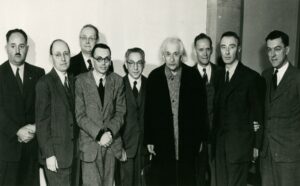
Albert Einstein’s 70th birthday celebration at the Institute for Advanced Study. Left to right: H. P. Robertson, E. Wigner, H. Weyl, K. Goedel, I. I. Rabi, A. Einstein, R. Ladenburg, J. R. Oppenheimer, and G. M. Clemence.
“We are humbled by this honor. Anything we can do to promote this venerated institute is nothing less than a blessing,” said Dr. Raminder Pathak, Chairperson of the Princeton Foundation. She adds further: “While the Foundation advocates bringing Institute’s research to the society sooner than later, it doesn’t aim to alter in any way the fundamental principles of the Institute. The Foundation endorses the importance of the Institute’s independent, curiosity-driven research. It will continue to support its unique environment for cultivating and nurturing new ideas and fields of inquiry, investment in the institute’s extraordinary Faculty, its ability to attract Members internationally, and to facilitate their research that has shaped the world and the ages.”
The Membership is being created in the School of Social Sciences at the Institute based on a global search. The term of the Member will start in the month of September 2017 for a period of one year.
(This PR is largely based on an article published previously. Please find the full article here)
